
Loading...
Serving Lompoc, CA and surrounding areas. (805) 944-3088
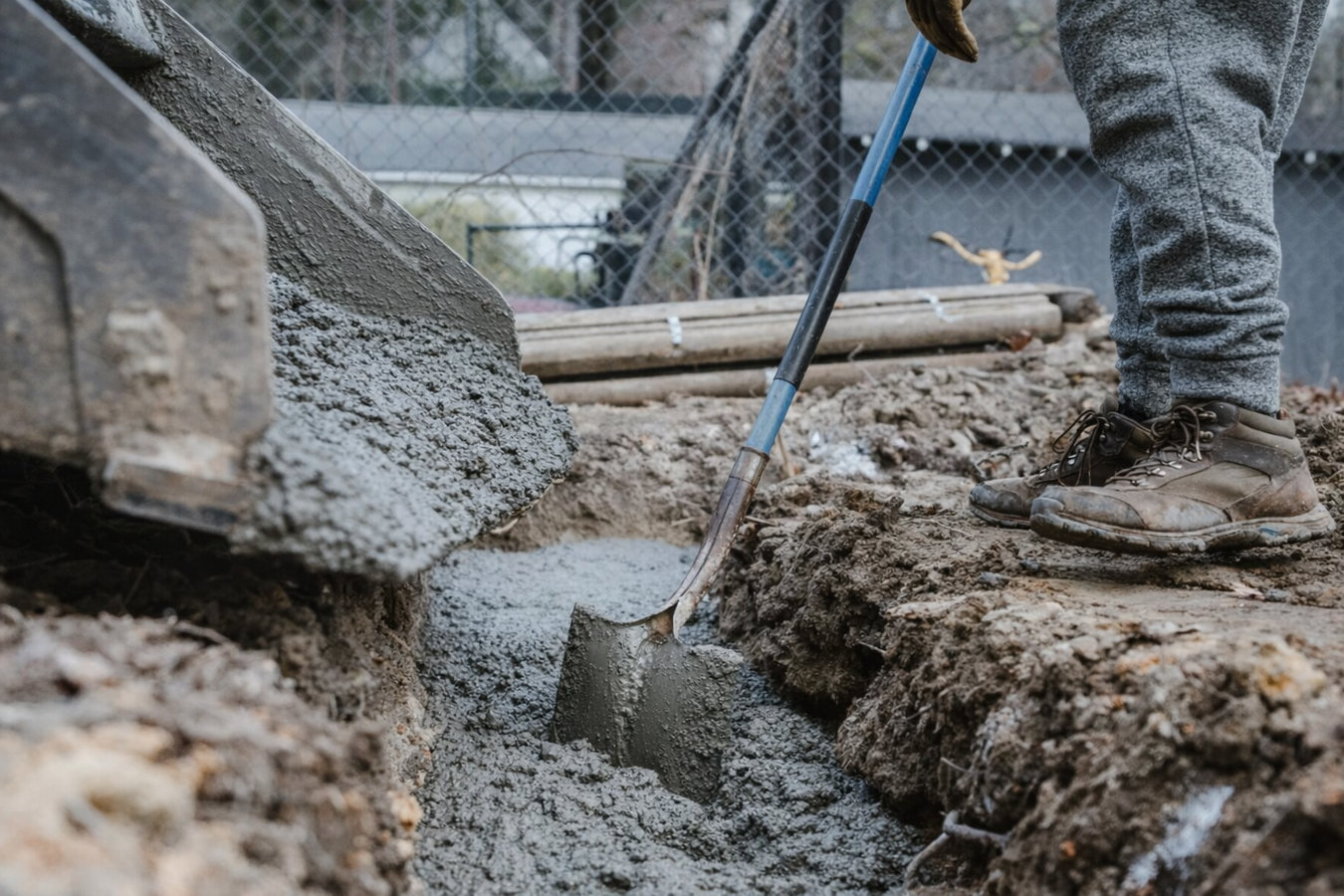
Building a deck, addition, or outbuilding in Lompoc? Get concrete footings poured to the right depth for local clay soils - fully permitted and ready for city inspection.
Concrete footings in Lompoc are the underground concrete base that supports a structure above - a deck, addition, shed, or pergola - by spreading the load across stable soil below, and most residential footing projects involve one to two days of active work followed by three to seven days of curing before building can begin on top.
Most homeowners never see their footings once the project is finished, which is exactly why getting them right matters. A footing that was not dug deep enough or did not include steel reinforcement will shift or crack under load, and by the time the problem shows up above ground, the fix is far more expensive than doing it correctly the first time. In Lompoc, where clay soils move with the seasons, this is a real concern - not a hypothetical one. If your project also requires a broader concrete foundation rather than individual footings, our foundation installation service covers that scope in full.
If an existing structure has already shifted because the footings beneath it settled, our foundation raising service can lift and stabilize it before new footings are added. We manage the permit process with the City of Lompoc Building Division from application through the pre-pour inspection. Call us or send a message and we will get back to you within one business day.
Cracks that angle out from the corners of your doors or windows - especially ones that have appeared or grown in the past year or two - often signal that part of your home's base is shifting. In Lompoc, where clay soils expand and contract with seasonal moisture, this kind of movement is more common than in areas with stable sandy soil. It does not always mean a catastrophic problem, but it means the footings deserve a closer look.
When a door that used to swing freely starts sticking, or a window that opened easily now jams, the frame around it may have shifted slightly. Frames shift when the structure they are attached to moves - and structures move when their footings settle unevenly. This is especially worth paying attention to in older Lompoc homes, where original footings may not have been built to handle decades of clay soil movement.
If you can see a gap opening up where your wall meets the floor, or where an interior wall meets the ceiling, something in the structure is moving. This kind of separation is a visible sign that different parts of the building are no longer moving together - which often points back to uneven settling at the footing level.
If a deck, shed, or outbuilding on your property has started to lean, tilt, or pull away from the main structure, the footings underneath it may have shifted or deteriorated. In Lompoc's clay-heavy soils, footings that were not deep enough or not reinforced can move significantly over time - especially after wet winters followed by dry summers. This is a safety issue, not just a cosmetic one.
We pour concrete footings for decks, room additions, ADUs, garages, sheds, pergolas, and retaining structures across Lompoc and the surrounding Central Coast area. Every project starts with a site visit to assess soil conditions, lot access, and what the structure above requires - we do not give firm quotes over the phone without seeing the property. When a project calls for footings that connect to a broader foundation pour, we coordinate both scopes under a single permit. If you are planning a full foundation replacement or new-build foundation rather than individual footings, our foundation installation page covers that work in detail.
Steel reinforcement is included where site conditions and the structure above require it - and in Lompoc's clay soils, that is most projects. The American Concrete Institute sets the standards for how concrete should be mixed, placed, and cured, and those standards inform how we approach every footing pour. We coordinate the city inspection before the footing is covered, so the work is verified by an independent set of eyes before it disappears underground.
For freestanding or attached decks and patios where individual pier footings need to be dug, formed, reinforced, and poured to carry the structure above.
For room additions, garage conversions, and detached ADUs where continuous or spread footings need to meet current seismic and load-bearing code requirements.
For garages, workshops, and storage structures where a concrete footing is required by the city before framing can begin - permitted and inspected.
For concrete retaining walls where a properly sized footing is needed below the wall base to prevent sliding or rotation under lateral soil pressure.
Two things make footing work in Lompoc different from a generic pour anywhere in California. First, the clay-heavy soils in the Santa Ynez Valley region swell when wet and shrink when dry - a cycle that repeats every year and puts real stress on footings that were not designed for it. A footing that sits at minimum depth on un-compacted clay will shift, and when it shifts, the structure above it shifts with it. Second, Lompoc sits in a seismically active part of California. Local building codes require footings to meet earthquake-resistant design standards that affect depth, reinforcement, and how the footing connects to the structure above. The city inspection process verifies this before the concrete is poured, which is a genuine benefit to you - it means someone independent of your contractor is checking the work while it can still be corrected.
A large share of Lompoc's housing stock was built between the 1950s and 1980s, and many of those homes have original footings poured to older, less stringent standards. We work regularly on addition and repair projects throughout the city, including neighborhoods in central Lompoc and communities near Vandenberg Village. Lompoc's rainy season runs from November through March - if your project falls in that window, we plan the pour carefully to protect the fresh concrete from heavy rain, and we can cover it if needed.
We ask what you are building, roughly where on your property, and whether you have spoken to the city about permits yet. You do not need all the answers - this call is just to figure out if the job is a fit and to schedule a free site visit. We reply within one business day.
We visit your property to check the site conditions - the slope, soil, access for equipment, and any existing structures nearby. Based on that visit, we give you a written estimate that breaks down the scope. This is the right time to ask how deep the footings will go and whether steel reinforcement will be included.
For most footing projects in Lompoc, we submit a permit application to the City of Lompoc Building Division before any digging starts. Permit approval typically takes a few days to a couple of weeks depending on project complexity. We handle this entirely on your behalf - you should not need to contact the permit office yourself.
The crew digs to the required depth, sets forms, places any steel reinforcement, and pours the concrete. A city inspector visits before the pour or before the forms are removed to verify the work. After the pour, the footings need at least three to seven days to cure before framing or other building work can begin above them.
Free on-site estimate. We handle the permit, coordinate the inspection, and give you a clear timeline before work starts.
(805) 944-3088In Lompoc, the City of Lompoc Building Division inspects footing work before it is covered. We pull the permit on your behalf and coordinate that inspection as a standard part of every project. You get an independent verification that the work was done correctly - not just our word for it.
Clay soils that expand with winter rain and shrink in summer are the main reason footings fail prematurely in this area. We dig to stable soil depth, assess whether reinforcement is needed for the specific site, and account for seasonal soil movement in how we design the pour. This is local knowledge that matters.
Lompoc sits in a seismically active region of California, and footings here must meet earthquake-resistant standards. The Santa Barbara County publishes seismic hazard information that reflects the real risk in this area. Every footing we build meets those standards - the city inspection confirms it before the work is covered.
Many homes in Lompoc were built in the 1950s through 1970s on footings that predate current standards. Adding onto one of these homes is not the same as starting from scratch. We assess existing footings before recommending whether to tie into them or add new ones alongside - a conversation that is better to have before the project is designed, not after.
Every footing we pour in Lompoc goes through a city inspection before it is covered - giving you independent verification of the work while it can still be checked. Confirm any California contractor is properly licensed at cslb.ca.gov before signing a contract.
If your existing footings have shifted and the structure above them has settled, foundation raising can restore the level and add new footing support beneath it.
Learn MoreFor projects that require a full concrete foundation rather than individual footings - new builds, replacements, and additions with a larger footprint.
Learn MorePermit season fills up fast - reach out now to lock in your start date and get a written estimate before the next inspection backlog.